Multibase
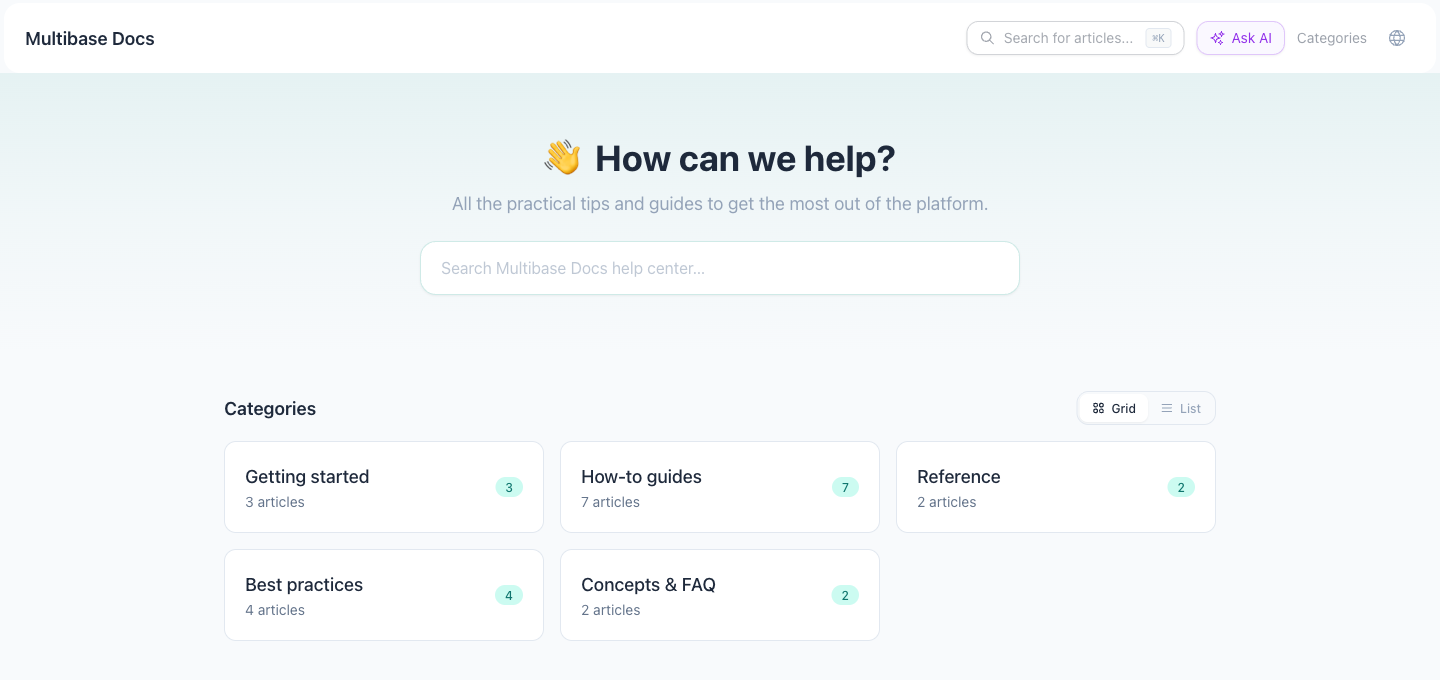
Multibase is a white-label knowledge base for companies that run more than one brand. Each brand gets its own help centre with its own look and content, managed from one account. Multi Labs builds and runs it. multibase.io
Why we built it
Most knowledge base tools charge per seat and keep white-label and multi-brand support for their most expensive plans. A company with three products and a small support team ends up paying to unlock features it should have from the start. We wanted pricing that grows with the number of brands, not the number of people.
There is a free plan. Paid plans cost $49, $149 and $399 a month on annual billing and include 3, 10 or an unlimited number of help centres.
How it works
The product is a NestJS API on PostgreSQL 16 and Redis, an admin app and a public reader app on Next.js, a shared package of TypeScript types and a Playwright suite that tests all of it together.
Every customer shares one database. Each row carries a tenant ID, every query goes through a tenant-scoped repository, and a CI check called tenant_scope_guard fails the build if a query skips that layer. For signed-in users the tenant comes from their token, never from a header the browser can change. Public help centres are matched to a customer by hostname.
Search falls back in steps: PostgreSQL full-text search, then a plain substring match, then fuzzy matching with pg_trgm, then the other languages of the same help centre. AI answers retrieve the relevant articles first, stream the reply and cite their sources. An MCP server lets AI assistants search and read a public knowledge base directly.
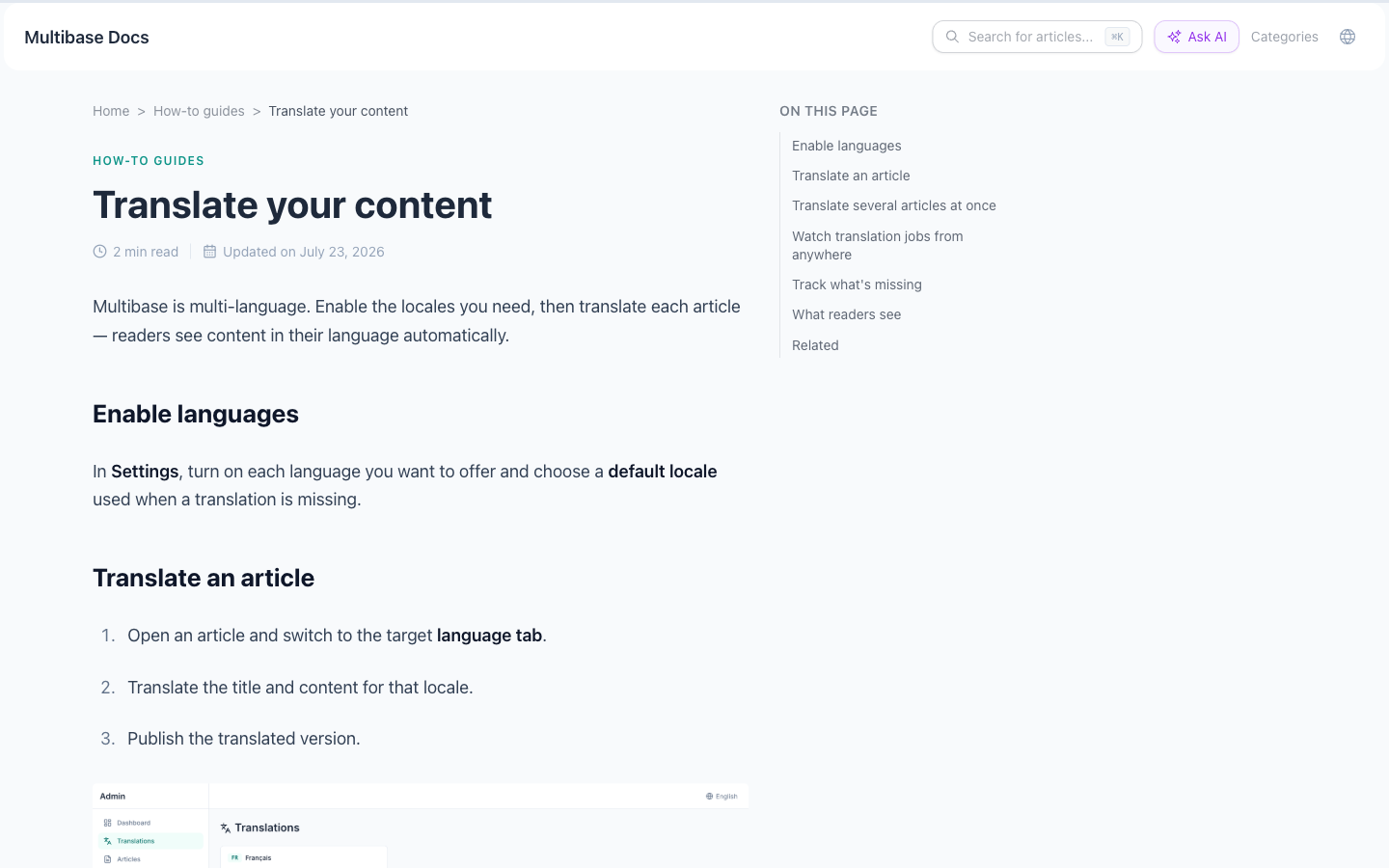
Articles exist in several languages, each with a draft and a published state. There is a review step with inline comments, and machine translation that can work through the most-read articles in bulk.
The API has 172 end-to-end tests. The browser suite has about 55 Playwright specs, including one that signs in as two different customers and checks that neither can see the other.
Timeline
- April 2026. The admin app handles sign-in, articles, categories and settings.
- June 2026. Multi-tenancy merges. The full end-to-end suite passes with 151 tests and no failures.
- July 2026. We build an MCP server and run a white-box security audit across all five codebases.
- September 2026. First production release. The first help centre in production is migrated from Intercom: 42 articles, 13 categories and 265 images.
What broke
A 57,000-character article failed to translate for four separate reasons stacked on top of each other. The last one was the real bug: a regular expression meant to strip a Markdown code fence around the model's JSON matched a fence inside the JSON itself and cut the payload in half.
The reader app cached failed tenant lookups, so a brief error turned into a full minute of a help centre being unavailable. It now caches only successful lookups, for 60 seconds.
One stream method in the AI SDK we use dropped provider errors without a trace. Reading the full event stream instead made those failures visible.
During the move to multi-tenancy, the end-to-end suite caught a unique index on slug redirects that only worked while there was a single customer.